Arts & Culture
Galleries, makers and music
The best arts & culture in Barossa Valley
Galleries, public sculpture and cultural festivals that give the Barossa its creative pulse.
Read our guide to arts & culture ↓Browse arts & culture by area
Angaston Blacksmith Shop & Museum
View →The A&H Doddridge blacksmith shop of 1873, worked by three generations of one family for 130 years and saved as a living museum by the community.
Barossa Chateau
View →A grand 19th-century mansion of art, antiques and rose gardens
A chateau-style estate at Lyndoch with rose gardens, a cafe serving high tea, a cellar door and gift shop.
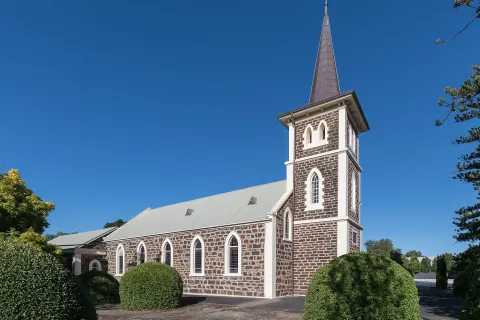
Gnadenfrei Lutheran Church
View →The 1873 church of St Michael on its vine-ringed rise at Marananga - one of the most photographed churches in the Barossa.
Greenock Aviation Museum
View →A volunteer-run hangar of vintage aircraft and aviation history
Herberge Christi Lutheran Church
View →The 1883 church at the heart of Bethany, the Barossa's first German village, with a bell brought from Germany that once called workers home at dusk.
Immanuel Lutheran Church, Light Pass
View →The elder of Light Pass's twin Lutheran churches, an 1886 building serving a congregation that dates from the 1840s.
Kapunda
View →Australia’s historic copper town on the Barossa’s edge
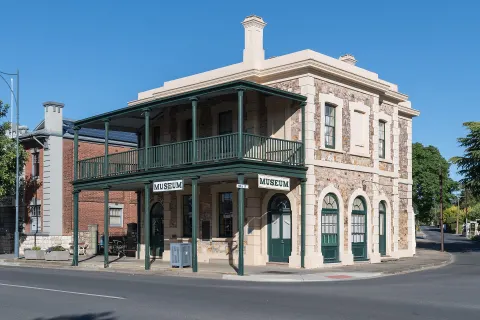
Kapunda Museum
View →Two packed floors of copper-town history in a grand 1866 Romanesque former Baptist church, run by volunteers since 1971.
Langmeil Lutheran Church
View →A historic Lutheran church in Tanunda whose surrounding precinct holds some of the Barossa's oldest German graves and stories.
Luhrs Cottage Museum
View →A pug-and-straw pioneer cottage from the 1840s, restored as a museum of early German settler life in the Barossa village of Light Pass.
Map the Miner
View →Kapunda's 7-metre Cornish miner - "Map Kernow, Son of Cornwall" - one of Australia's Big Things, rebuilt after a 2006 fire.
Mengler Hill Sculpture Trail Free
View →A short hilltop walking loop dotted with stone sculptures, beside the Barossa's most famous lookout.
Seppelt Family Mausoleum
View →A Doric-columned Grecian tomb of 1927 on a quartzite ridge above Seppeltsfield's avenue of palms, resting place of the famous wine dynasty.
St Petri Lutheran Church
View →A landmark red-brick Lutheran church in Nuriootpa, one of the most prominent of the Barossa's many heritage churches.
Strait Gate Lutheran Church
View →One of Light Pass's famous twin churches - a striking modernist 1961 building beside the bell tower of its 19th-century predecessor.
Tanunda Heritage Walk
View →A self-guided stroll through the valley’s German heart
Z Wine $$
View →A sister-run cellar door on Tanunda's main street pouring contemporary Barossa and Eden Valley wines in a stylish urban space.
About arts & culture in Barossa Valley
The Barossa's creative life runs deep, shaped by its German Lutheran roots, its band and choral traditions, and a contemporary community of artists drawn to the valley's light and landscape. Culture here is woven into everyday life as much as it sits in galleries.
The open-air Mengler Hill Sculpture Trail sets carved stone figures against a sweeping valley backdrop, while the Barossa Sculpture Park above Tanunda pairs art with one of the region's finest lookouts. Historic Lutheran churches such as Langmeil are cultural landmarks in their own right, and several cellar doors double as galleries and music venues.
The calendar brims with events, from the Barossa Vintage Festival to brass band concerts and Liedertafel performances. Pair a gallery visit with the valley's heritage sites for a richer sense of the place and its people.
Arts & Culture in Barossa Valley - frequently asked questions
What is the Barossa Valley known for when it comes to arts and culture?
The Barossa's creative identity is rooted in its German Lutheran heritage, which gave rise to enduring band and choral traditions - the Tanunda Town Band, formed in 1857, is often described as the oldest continuous brass band in the Southern Hemisphere, and the Tanunda Liedertafel male choir traces its origins to 1850. Alongside this living musical culture, the valley draws contemporary artists and makers to its landscape and light, with public sculpture, regional galleries and heritage museums woven through towns like Tanunda, Angaston and Light Pass.
Where can I see public sculpture and galleries in the Barossa?
The standout open-air destination is the Barossa Sculpture Park on Mengler's Hill near Tanunda, created during the 1988 Barossa International Sculpture Symposium where sculptors carved site-specific works in local marble and granite, all set against sweeping views over the valley. For exhibitions head to the Barossa Regional Gallery in Tanunda, and for heritage you can explore the historic Angaston Blacksmith Shop & Museum, one of the last main-street forges in Australia, established in 1876.
Is there an entry fee, and do I need to book?
Many of the Barossa's cultural highlights are free and open to the public, including the Barossa Sculpture Park on Mengler's Hill, which you can wander any time at no cost. The Barossa Regional Gallery in Tanunda is also free to visit, though it keeps limited days and hours, so it is worth checking current opening times before you go. Smaller heritage museums can have seasonal or volunteer-run hours, so booking ahead or confirming opening days for those is sensible.
When is the best time to visit the Barossa for arts and cultural events?
Autumn is the cultural high point thanks to the Barossa Vintage Festival, held every two years to mark the end of the grape harvest. First staged in 1947, it is one of Australia's longest-running wine festivals and packs in parades, long lunches, art exhibitions and live music across the valley, with the next event scheduled for 21 to 25 April 2027. Outside festival years, galleries, museums and band performances run throughout the year, so there is always something on.
How does the Barossa's German Lutheran heritage shape its culture today?
The valley was settled from the 1840s by German Lutheran families, and that history is still visible in its bluestone churches, cottages and traditions. Light Pass alone has two Lutheran churches whose bells still ring on Sunday mornings, a legacy of a 19th-century split in the congregation, and the broader heritage lives on through brass bands, four-part Liedertafel singing and food traditions like bockwurst and sauerkraut that appear at cultural events. Churches such as Immanuel and Gnadenfrei remain among the region's most evocative cultural landmarks.